
Checking Criminal History in Lone Tree
Choose the channel by the question. Lone Tree Police is the source for its event report and media. Municipal Court staff handle city-level cases. DCSO holds a county booking, and Douglas Combined Courts holds filed Colorado charges. CBI ICHC supplies statewide name-based history.
- Request the Lone Tree Police report with the city form, photo ID, and precise event details.
- Use the city’s online reporting route only for an eligible nonemergency with no known suspect.
- Contact Lone Tree Municipal Court directly for an ordinance, traffic, motion, or warrant question.
- Move to DCSO for booking records and Combined Courts for state charges.
- Use CBI ICHC for Colorado-wide history, then verify dispositions in the source court file.
This sequence prevents a current custody result from being mistaken for a conviction and a police report from being mistaken for the charge the prosecutor filed.
Why Lone Tree Forms Need Adobe
Lone Tree’s police request has an unusual technical instruction. Download the PDF and open it in Adobe to use the red Submit button. Complete all fields, e-sign the form, and attach photo identification. Opening the file only in a browser can leave the submit function unusable even when the entries look complete.
A requester may instead print the form, scan it, and email it to ltpdrecords@cityoflonetree.com. Postal requests should include payment and a self-addressed stamped envelope. These are alternate routes to the same Police Records function at 9220 Kimmer Drive, Suite 120, phone 303-799-0533. Keep a copy of the completed form and identify the precise report, photo, audio, or video requested.
Lone Tree Police Department Records
Lone Tree Police can review requests for reports, photographs, 911 audio, and body-camera material. Many requests have a published three-to-five-business-day approval period, though redaction or withholding under Colorado law can affect the actual time and result. A clear incident date, location, person, and case number narrows the search.
The police file is not the municipal docket. It records the report and investigative material held by LTPD. If a person was booked at the Douglas County jail, DCSO is the custodian of the booking file. If prosecutors filed a state charge, the court outcome belongs to Douglas Combined Courts. Lone Tree’s form and identity requirement do not authorize release of protected victim, juvenile, investigative, or other restricted information.
Lone Tree Online Report Menu
The online reporting system accepts a defined group of incidents: an unattended public-road crash, private-property crash, graffiti, vandalism or property damage, private-property hit-and-run, identity theft, lost property, theft, theft from a vehicle, harassing calls, and vehicle vandalism. It is not a general intake for every crime.
The event must be a nonemergency inside Lone Tree. The reporter must be at least 18, have email access, and have no known suspect. A known suspect or urgent risk requires direct police contact, not the web form. After review, the submission can receive confirmation, a case number, and a printable report. The city warns that online submission may not lead to investigation, and false reporting remains an offense.
Lone Tree Paper and Digital Fees
The city separates paper and digital products. A paper record costs $5 including two pages, then $0.25 per page. Labor is $33.58 per hour after the first included hour. A digital record costs $25 including one hour, then uses the same $33.58 hourly rate. The format and review burden can therefore change the total.
| Paper record | $5 including two pages |
|---|---|
| Added paper pages | $0.25 per page |
| Digital record | $25 including one hour |
| Added labor | $33.58 per hour after the included first hour |
| Postal route | Include payment and a self-addressed stamped envelope |
Ask for the exact report or time segment rather than an open-ended archive. A narrow request can reduce search, review, and redaction work.
Lone Tree Arrests and Bookings
Lone Tree officers transport arrestees to the Douglas County jail rather than maintaining a separate public city booking system. LTPD retains the officer report; DCSO creates the booking card, booking report, custody, and probable-cause material. One Lone Tree event can thus require requests to both agencies.
Use DCSO Inmate Inquiry for current or recent custody and call Booking at 303-660-7550 if the inquiry is unavailable. The inquiry cannot establish a final court result. Release does not mean acquittal, and a no-result does not prove that no older Lone Tree arrest exists. The Douglas County arrest lookup covers the county request chain without turning this city page into a jail guide.
Three to Five Days for Lone Tree Media
Lone Tree’s three-to-five-business-day period commonly applies to approval of reports, photos, 911 audio, and body-camera records. It should not be read as a guarantee that every file will arrive unredacted within five days. The custodian still reviews privacy, investigative, juvenile, and other statutory limits.
Large video or audio requests may also involve more labor than a short paper report. State the date, location, event, time segment, and officers or case number when known. If the city needs more detail, answer the scope question before submitting a duplicate request. The approval clock concerns Police Records material, not the time for Municipal Court to rule on a motion or for CBI to update a disposition.
Municipal Court Records in Lone Tree
Lone Tree Municipal Court is at 9220 Kimmer Drive. Call 303-339-8177, email court@cityoflonetree.com, or fax 303-225-4949. Hours are Monday through Friday, 8 a.m. to 5 p.m. No official public self-service portal was found, so direct court communication is the dependable lookup route.
| Court Name | Lone Tree Municipal Court |
|---|---|
| Case Types Heard | City ordinance and municipal traffic matters |
| Lookup Channel | Phone, email, fax, or current court counter |
| Timing Rule | Motions and requests are due ten days before the hearing |
| Insurance Dismissal | Signed insurer letter on letterhead; a card, bill, or policy alone is insufficient |
State charges are not converted into municipal files merely because Lone Tree Police made the arrest.
Lone Tree Insurance Letter Rule
For an insurance-related dismissal, Lone Tree requires a signed letter from an insurer representative on company letterhead. An insurance card, bill, or policy alone does not meet the published instruction. This local evidence rule can trip up a person who brings proof of coverage but not the exact court document requested.
Contact court staff before the deadline if the letter cannot be obtained. Motions and requests are due ten days before the hearing under the city’s guidance. The clerk can explain filing procedure but does not turn a late or incomplete document into an approved dismissal. Keep the municipal case number on the submission and do not confuse it with the police incident number.
Where Lone Tree Records Go
Lone Tree Police retains the local report. A city ordinance case stays in Municipal Court. State charges proceed through Douglas County courts, and a custodial arrest creates a DCSO booking record. Fingerprints and reported dispositions can later update CBI criminal history.
Record flow: Lone Tree Police Department › Douglas County Courts › Colorado Bureau of Investigation
These systems do not update at once. A police report may exist before filing, and a court disposition may close before the state history reflects it. Verify the outcome with the source docket. For filed state charges, the Douglas County criminal court case guide explains the county record without displacing Lone Tree’s local sources.
Lone Tree Police at Midnight
Lone Tree once relied on DCSO for city policing. The city shifted to its own Police Department at midnight when the population was about 8,000. That transition is a practical clue for historical research: the likely custodian may depend on when the event occurred and which agency handled it.
Modern LTPD records go to the current Kimmer Drive Police Records channel. For an older event handled by DCSO, provide the old date, location, and any agency or case identifier to the Sheriff’s Records Unit. Do not assume that the creation of LTPD transferred every old DCSO report into a city database. Court files and jail records remained separate systems throughout the change.
Current Lone Tree Offices and RidgeGate
A combined Justice Center is planned in RidgeGate east of I-25, but it is not the present records address. Use 9220 Kimmer Drive for current Lone Tree Police and Municipal Court contacts until the city officially opens and publishes replacement access instructions.
Future consolidation could change where a counter operates without changing which office owns a police report or court file. A searcher should check the official city source before visiting rather than relying on a planning announcement. Current address accuracy matters for mailed forms, payments, self-addressed envelopes, and the ten-day court deadline. The planned building should not appear as the custodian of a record it does not yet house.
Public Access Rules in Lone Tree
LTPD criminal-justice records fall under CCJRA. General city administrative records use CORA, and court access follows the proper judicial rules. The city-clerk records route uses a three-working-day baseline with a possible seven-day extension for extenuating circumstances. Police release still depends on criminal-justice protections.
Key Statutes:
CCJRA, C.R.S. 24-72-301 through 24-72-309 - governs criminal-justice record access, custodian review, and protected content.
CORA, C.R.S. 24-72-200.1 through 24-72-206 - provides the general city-record inspection and timing framework.
C.R.S. 24-72-305.5 - prohibits specified direct solicitation for pecuniary gain.
The official Lone Tree Police page is the city source pictured below.
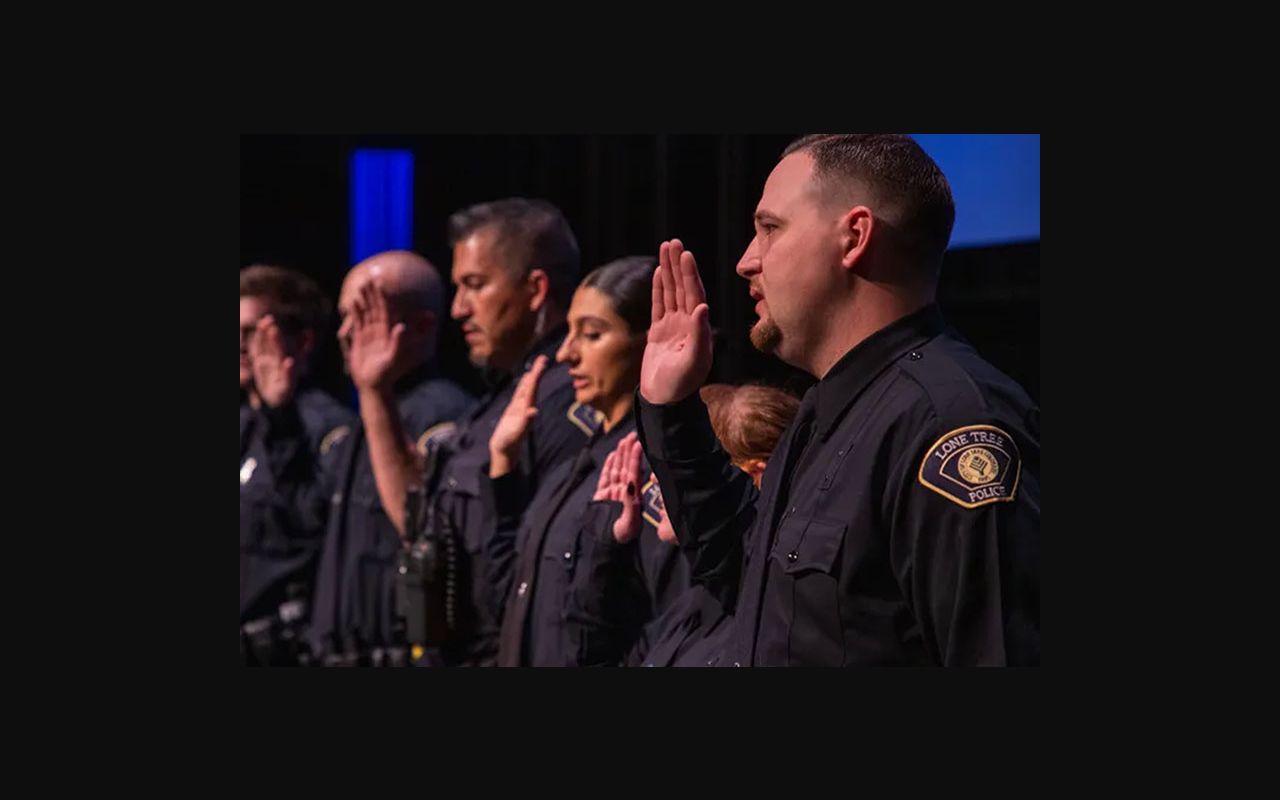
The page identifies the local police channel, not a countywide or statewide history database.
Lone Tree Court and Sealing Sources
The Municipal Court page is the right source for the city docket and its local deadlines. The official Lone Tree Municipal Court page appears below.
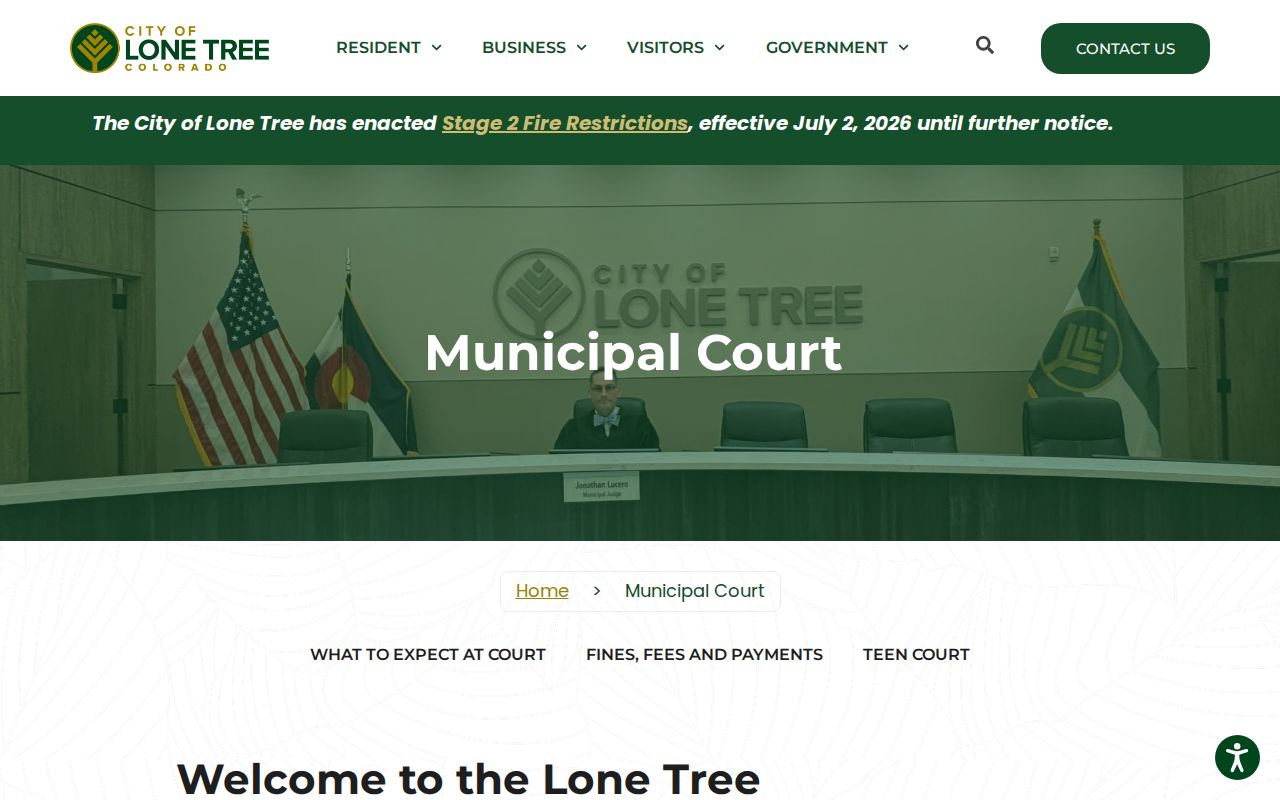
Use the court contact to confirm a filing, motion, warrant question, or local outcome.
When a Colorado court enters a sealing order, CBI has a separate implementation role. The official CBI sealing-order page is captured below.
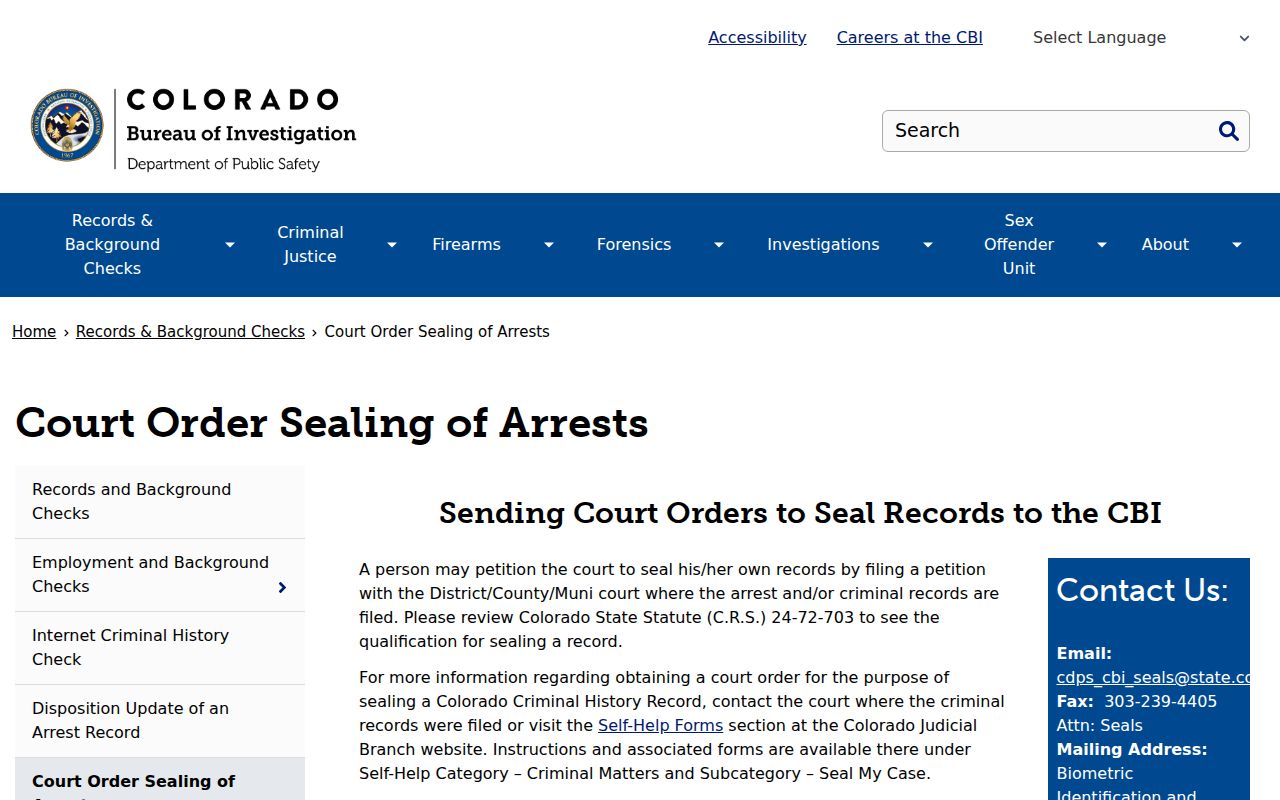
An entered order can take time to reach each custodian, so confirm both the source court action and the later repository update.